



✕


Englisch
Übersetzung
Óðinn
Alone sat she outside when the aged one arrived
the young-old ása and into my eyes looked. What do you ask me?
Why do you test me? All know I,
Óðinn, where your eye is hidden, in the glorious well of Mimir.
Mimir drinks the mead every morning from Valfathers wager.
You know now - or what?
 N0rseN
Kommentare
Russland führt einen schändlichen Krieg gegen die Ukraine. Stehen Sie an der Seite der Ukraine!
Über den Übersetzer
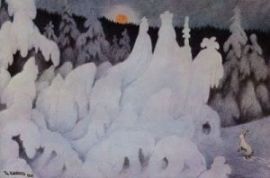

Vǫluspá stanza 28.
Odin seeks the ancient Volva asking her to look into the past, the present and the future. The volva, now altering between talking about herself in the first and third person, sees widely into all the worlds, looks back to the beginning accounting for major events up to the present time, until she arrives at this moment when Odin seeks her. As she reveals Odin once came to the Well of Mimir but was denied before he wagered one of his eyes. This is offcourse a riddle which is better understood by understanding who Odin is first and foremost.
Odin carries many attributes and a variety of names and teachings on his journeys. Common to both context, attributes, names and teachings is that Odin is associated with the spirit and the metaphysical. Odin means thought and spirit, it is life's thought and human spirit. His attributes, possesions and journeys are all related to the same, at different levels. Like the raven Huginn means thought, logic and reason, and the other raven Munin means memory, inspiration, desires and will.
Wells, rivers and water is the boundaries between worlds, the distinction between living and dead, between different states and the link to ancestors, memories and guidance.The fact that Odin specifically sacrificed an eye is surely significant. In all ages and most cultures, the eye has been “seen” as a poetic symbol for perception in general, that use vision as a metaphor for perceiving and understanding something. Given that Odin’s eye was sacrificed in order to obtain an enhanced perception, it seems highly likely that his wager of an eye symbolizes trading one mode of perception for another.
What mode of perception was exchanged for what other mode, then? The answer to this question lies in the character of Mimir. Mimir, whose name means “The Rememberer,” seems to have been the being who told the gods how to live in accordance with ancestral tradition, memories and with wisdom more generally.
Similiar to how Odin unveiled the runes, Odin sacrificed what we might call his “lower self” to his “higher self.” Here, his relinquishment of an eye should surely be understood along similar lines: he exchanged a profane, everyday mode of perception, beleaguered with countless petty troubles, for a sacred mode of perception informed by divine, ancestral wisdom.