




 turcanin on 2011-11-25
 Miley_Lovato,
  Enjovher
Lyrics powered by www.musixmatch.com

 evfokas
  annabellanna
Tue, 06/10/2015 - 10:55
annabellanna
Tue, 06/10/2015 - 10:55
I wonder how so many people could translate(I see translation in english, ucraine,bulgarian, serbian, tongan...) a text written in a no-language that have no meaning.
Really, can anyone explain me please how did you do?
 ϕιλομαθής
Tue, 06/10/2015 - 10:59
ϕιλομαθής
Tue, 06/10/2015 - 10:59
:) Have you ever read "The Emperor's New Clothes"? https://en.wikipedia.org/wiki/The_Emperor%27s_New_Clothes Maybe this is a similar phenomenon.
annabellanna
Tue, 06/10/2015 - 11:02
:bigsmile:
 Lobolyrix annabellanna
Fri, 23/11/2018 - 09:46
Lobolyrix annabellanna
Fri, 23/11/2018 - 09:46
Maybe I haven't been clear enough: it's impossible to translate a text with no meaning
annabellanna
Fri, 23/11/2018 - 18:30
Maybe the other translators have more imagination than me: despite all my efforts I can't find any meaning in this jumble of unknown words.
Sciera, according your previous post, "it sounds like latin but has no meaning".
Then, please, tell me in which manner someone could translate it.
 Sciera
Fri, 23/11/2018 - 19:48
Sciera
Fri, 23/11/2018 - 19:48
Well, even for Pseudo-Latin this one is difficult. If I add one letter to the first line ("adaptare" instead of "adapare"), I could translate it as:
"Of the gift I take myself away, to adapt me of the gift"
Not that this makes sense.
I have no idea how the other translators here came up with their versions.
 Κακομάζαλη
Mon, 05/02/2024 - 03:19
Κακομάζαλη
Mon, 05/02/2024 - 03:19
I think that pseudo-Latin shouldn't be considered as a language. It's gibberish, there is not a grammar, vocabulary, nothing to refer to. Each writer claiming to "speak" pseudo-Latin is creating an idiom oh his own. And we all try to understand it without having a clue. It's pointless.
 clgr
clgr  Interpres
Sat, 27/09/2025 - 11:43
Interpres
Sat, 27/09/2025 - 11:43
I think it's high time to clear up the growing disputes and misunderstandings surrounding the language in which this piece is performed.
What language is this?
It's pseudo-Latin, a language created for artistic purposes, intended to sound like Latin, but not being a grammatically or semantically correct Latin text.
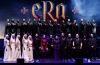
The band "Era," founded by Éric Lévi, specializes in combining choral, Gregorian, and electronic music, often using fictional languages to give their pieces a mystical, timeless atmosphere.
Why does it sound this way?
"Dori me," "Ameno," "Imperavi"—these are words that resemble Latin forms but don't form logical sentences.
The sound is intended to evoke emotion, spirituality, and mystery, not to convey specific meaning.
Fun fact:
The song "Ameno" gained immense popularity in the 1990s and later on the internet, often used in memes, films, and games, precisely because of its enigmatic nature.
Interpres
Sat, 27/09/2025 - 11:45
Doubts about the so-called translation (it's only surprising that the moderator or anyone else from the LT editorial team accepted and approved this "translation creation"). My doubts are fully justified, and what we received as a "translation" is more of an emotional interpretation than an actual translation.
The song "Ameno" by the band "Era" is not written in any known language - it is an artificial language, inspired by Latin, created solely for its sound, rhythm, and atmosphere.
Interpres
Sat, 27/09/2025 - 11:46
Why can't it be translated literally? Words like "dori me," "omenare," "imperavi," and "matiremo" have no meaning in Latin or any other language. They're phonetic constructions intended to evoke mystical, spiritual associations, without any specific message. Attempts at translation are subjective interpretations, often emotionally or poetically charged—as in the text you submitted. What do I think of this "translation"? It's a creative attempt to convey the mood of the work, not a translation of its meaning—because there's simply no literal meaning. Phrases like "Ameno, Katedro" or "Usypuj mnie, winnego" sound dramatic and poetic, but they don't derive from any real meaning of the source text. This can be considered an emotional adaptation—a sort of "what does this work mean to me" rather than "what does it say."
Summary:
"Ameno" - artificial language, stylized after Latin - no literal meaning,
"Translation" - poetic interpretation - emotional vision, not translation.


Official audio with the album version, as the one used in the video is a remix:
Video added by SilentRebel83 on 08/15/12.